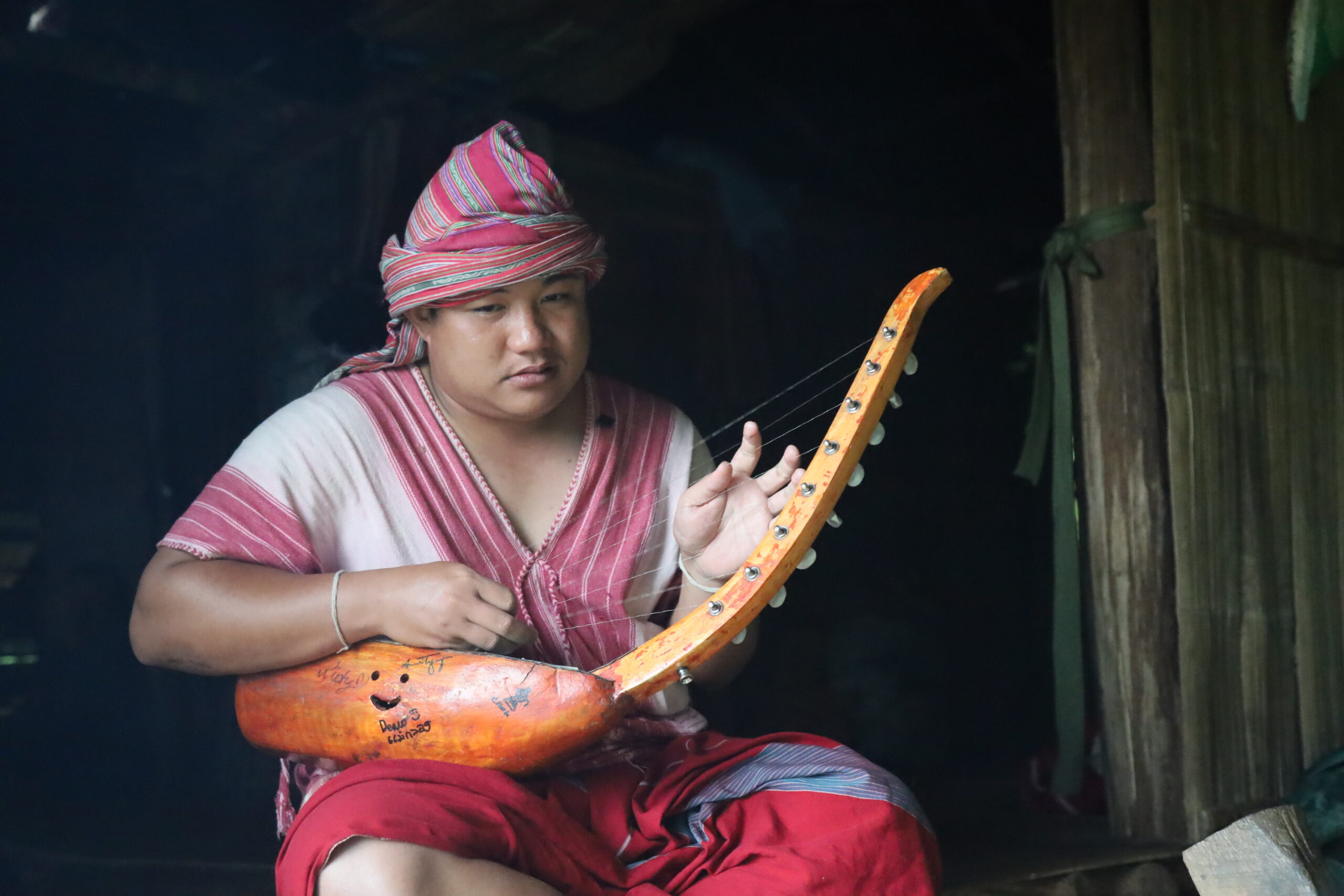
“เมะยื่อญากว่าบือพิ บือพิ เจอจึล่อโอ๊ะดิ เมะยื่อญากว่าบือเคลอะ บือเคลอะ เจอจึลิอโอ๊ะทอ”
ถ้าคิดถึงฉันให้มองดูข้าว ข้าวเป็นฝีมือของฉัน ถ้าคิดถึงฉันให้มองดูข้าว ข้าวคือรอยมือที่ฉันทำ
“คุณยายเล่าว่า เมื่อก่อนธาคือภาษาปกติของผู้คน ใช้เหมือนการพูดคุยกัน ไม่มีกฎเกณฑ์ต้องคล้องจองหรือทำนองไพเราะ เพราะออกมาจากใจและสามารถใช้เป็นแนวทางในทุกขณะของการดำเนินชีวิตได้ ธาจึงมักปรากฏในทุกเรื่องเลย แต่ทุกวันนี้แทบไม่มีให้เห็นแล้ว” tha was once the ordinary language of the people, used just like everyday conversation. There were no rules about rhyme or beautiful melodies, because it came straight from the heart and could guide people through every moment of life. That’s why tha found its way into every part of life. Today, however, few people still use it.”
Moreover, in an era when the world is confronting an environmental crisis, and the decline in forest cover is often invoked in political and social discourse to stigmatize forest-dwelling communities, the wisdom embedded in tha may prove to be the simplest yet most sustainable answer to maintaining ecological balance, as reflected in a tha verse handed down by earlier generations of the Pgaz K’Nyau:
“Tee-graer-oh-poe-tar-toe-graer, no-graer-oh-poe-tar-toe-graer, ku-see-glaw-see-sae-toe-graer, ku-see-daw-see-wa-toe-graer, sae-wa-mae-loe-u-loe-pae, poe-ba-koe-wee-poe-ba-koe-chae”
Pure water is found in the forest. Healthy ponds are found in the forest. Do not fell the trees. Do not cut them down. If the trees disappear, we too shall starve.
This teaching is more than a simple prohibition, but the very heart of stewardship, revealed through the practice of rotational farming—the spiritual core of the community. Even the felling of a single tree to make way for cultivation can become the beginning of irreversible loss. This verse of tha is therefore expressed as a lament, so that the tree stump may sprout new leaves, put out new branches, and continue growing in nature’s own cycle, allowing people to have enough to eat and use in a sustainable way.
This report, Tha Pgaz K’Nyau: Life’s Verses and the Truth of the Forest, invites readers to explore the ideas embodied in the verses of tha, revealing that this tradition of communication, much like ancient teachings, does far more than bind together the hearts of the people of Ban Mae Yang Min. It is also a voice for environmental ethics—a moral compass that continually reminds humanity of an essential truth: to protect the forest is to protect the very breath of life and to preserve one’s own lineage.
Ban Mae Yang Min’s Pgaz K’Nyau: A Worldview of Nature and Community Activities Constrained by Government Policy
Ban Mae Yang Min, Si Thoi Subdistrict, Mae Suai District, Chiang Rai Province, has a population of 329 people living in 98 households, with a total area of 12,847 rai1. The village lies in rugged, mountainous terrain with steep slopes and high mountain ranges, where mixed agriculture and highland farming are practiced alongside ongoing efforts to conserve the remaining community-use forest. These include patrol teams to prevent forest encroachment, forest fire watch teams stationed at fire lookout towers, reforestation and forest restoration activities, collaborative efforts to build check dams to improve water storage, and—before the start of each growing season—the construction of communal reservoir (fai luang) or water channels that convey water from natural sources to individual farm plots.
For the Pgaz K’Nyau of Ban Mae Yang Min, the choice of where to settle was never based solely on convenience. Instead, the landscape was divided into clearly defined zones. Steep slopes and mountain peaks were regarded as sacred areas, protected as headwaters and the dwelling places of sacred spirits. Separate spiritual zones were designated for rituals honoring the village guardian spirit, the spirit of the headwaters, and for burial grounds, establishing clear boundaries between the human and spiritual realms. Other areas were reserved for settlement and cultivation. The location of a village or agricultural plot was chosen according to its proximity to water sources and streams, following careful surveys of the surrounding landscape and divination rituals rooted in traditional beliefs to seek the approval of the guardian spirits of the land.
Every Pgaz K’Nyau child is welcomed into the world through a ritual known as de-por-thu, a ceremony that symbolically binds a person’s life spirit to a tree. The baby’s umbilical cord is placed inside a bamboo tube tied to a tree, symbolizing the enduring bond between people and the forest. Mr. Boonrit Teja, the village head of Village No. 4 in Mae Yang Min, explained:
“We place the baby’s placenta in a bamboo tube and tie it to a tree so that the child’s life spirit will grow strong and flourish, just like the tree to which it is bound. No one is ever allowed to cut that tree down. This ritual transforms each tree into a tree of life, which is spiritually connected to its human guardian. As a result, the forest surrounding the community is protected by the belief that destroying a tree is no different from destroying the life spirit and the life of the community members.”
The way of life in Ban Mae Yang Min follows a calendar shaped by traditional beliefs and seasons, especially the practice of rotational farming. A plot of land is cultivated for one or two growing seasons before cultivation shifts to a nearby plot, allowing the soil to rest and regain its fertility. The land is then left fallow for five to seven years before being cultivated again.
However, following a series of policy changes, particularly the impact of the Fifth National Economic and Social Development Plan (1982–1986) which introduced measures on forest management and the administration of hill tribes as part of its rural poverty alleviation and the distribution of social services, while also establishing natural resource management policies that set an annual target of reforesting 300,000 rai. In the context of protecting watershed forests2,the plan further called for measures to halt and restrict forest destruction, which was attributed to the “shifting cultivation” practiced by hill tribes. This was reinforced by the Cabinet Resolution of 28 May 19853, which introduced watershed classification and land-use control measures that became rigid regulations and policy barriers. Under the resolution, Class 1A watershed areas—headwater forests that remained in pristine condition or were designated as critically important watershed forests—were placed under strict protection. Land use of any kind was prohibited, and forest areas could not be converted to any other use. These policies effectively made the traditional practice of rotational farming impossible by default. The current village head of Village No. 4 recalled that the atmosphere at the time was filled with tension, as he himself had been hired to prepare land for reforestation.
“We stopped practicing rotational farming in 1984–85, when the Upper Mae Lao Left Bank Watershed Rehabilitation Reforestation Project was introduced. Instead of farming, villagers were hired to clear land and prepare sites for reforestation. At the time, none of us realized that we would no longer be able to practice rotational farming in the years to come. It wasn’t only the villagers who felt the pressure. Even officials told us that they were under pressure as well, because they were on the front line dealing with the community. That’s why the restrictions were not strictly enforced at first.”
As these challenges continued, and as the people of Ban Mae Yang Min found themselves increasingly constrained by government policies within their own community, government programs also began promoting the cultivation of alternative crops. Over the past 40 years, the community’s main agricultural products have therefore been upland rice, bananas, legumes, chilies, eggplants, and other vegetables.
Nevertheless, a quantitative biodiversity survey conducted under the Thai Climate Justice for All Project by the Local Development Institute, in collaboration with community volunteer leaders from Ban Mae Yang Min, has been underway since March 2024. Additional field surveys are currently being carried out before the findings are compiled and published. To date, the survey has documented at least 37 plant and tree species, 119 species of medicinal and edible plants, and 65 animal species. According to Mr. Boonrit Teja, the current village head of Village No. 4 in Ban Mae Yang Min, the community’s farming traditions and practices are organized around the seasons and a calendar shaped by traditional beliefs, and can be categorized as follows:
Current Calendar of Agricultural Activities and Related Rituals
| Period/Month | Activity/Ritual Name | Practices and Beliefs |
|---|---|---|
| January | Ki Ju (Wrist-Tying New Year Festival) | A celebration of the Pgaz K’Nyau New Year, which is not tied to the Gregorian New Year and may be held anytime from early January to mid-February, usually after the harvest season has ended. The central ritual is a wrist-tying ceremony to recall one’s life spirit, bestow blessings, and prepare for the coming planting season. |
| February | Ti Khu – Ti Phae, or Observing the Tong Flower to Determine the Land-Clearing Season | The tong trees growing in the highlands of Ban Mae Yang Min have slender trunks and produce large red blossoms that bloom simultaneously, covering the foliage. During flowering, the trees attract many nectar-feeding birds. Land clearing begins only after the flowers have withered and the birds begin to disperse, as birds are among the main threats to crop yields. |
| March–April | Land Preparation | Field burning, the creation of firebreaks, and the preparation of irrigation channels for cultivation. In Ban Mae Yang Min, fields are usually burned after 4 p.m., when the winds are calmer, making the fire easier to control and reducing the risk of it spreading. This work is typically carried out collectively through the ao mue ao wan (traditional mutual labor exchange) system, allowing community members to monitor the fire together. |
| May | Start of the Planting Season | Sowing vegetable seeds and planting the main crops. In addition to rice, which remains the community’s principal crop, bananas have also been cultivated since 2021 using chemical-free methods, following recommendations from the Watershed Management Unit4 under the Protected Areas Regional Office 15 (Chiang Rai), Department of National Parks, Wildlife and Plant Conservation, because bananas can be harvested throughout the year. |
| June | Offering to the Village Guardian Spirit5 and the Water-Source Spirit | The largest annual ceremony in the agricultural calendar, held to pray for a successful farming season. The community prepares si, a tradition in which unmarried men collect rice from every household to brew rice liquor. Throughout the ceremony, all farming activities are suspended, and picking flowers is strictly forbidden. |
| July–September | Tending the Fields | Setting up dokuli6 to deter crop pests, weeding, applying fertilizer, performing rituals at individual family fields, and making offerings to the weir spirits located at the head and tail of each household’s fields. |
| September–October | Buffalo Spirit-Calling Ceremony | A ceremony held to call back the animals’ life spirits and express gratitude for their contribution to farming. Today, however, it is no longer observed as a regular annual event and is often combined with other merit-making ceremonies before the harvest season later in the year (November–December). |


When Tha Is More Than Words or Legend: A Community’s Code and the Voice of the Forest
In Ban Mae Yang Min, tha is far more than a melody sung for entertainment. It serves as a means of social and spiritual guidance, helping to shape the behavior and worldview of people within the community. One of its defining characteristics is the use of kon bot—a poetic technique based on wordplay that makes lengthy teachings easier to remember. At the heart of tha is the use of nature as a mirror through which truths about human life are revealed. As Mr. Tip Jaithiang, affectionately known as “Uy Tip,” an elder whose recitations of tha were recorded and broadcast by Radio Thailand Chiang Rai (FM 95.75 MHz)7 in late 2006, recalled:
“When composing a verse of tha, there is no need for rhyme. Instead, we use figurative language to express meaning. We often compare a young woman to a flower, and lovers to birds, making the imagery easier for listeners to visualize.”
Beyond serving as an unwritten community code that provides social and spiritual guidance, shapes behavior, and reflects the relationship between people and nature, tha also plays an important role in maintaining social order. It serves as a gentle form of public admonition to maintain moral standards. When someone violates a customary norm—for example, by failing to uphold expectations of sexual propriety—elders do not resort to harsh words. Instead, they recite a pointed yet gentle verse of tha directly to that person, encouraging a sense of shame, and self-improvement, such as:
“Pho-sa-ho-loe-a-na-lo, Toe-ba-jee-toe-ba-koe-toh”
(A good child does not misbehave; there is no need for scolding or reproach)
On the other hand, tha also serves as a form of entertainment that helps ease the hardships of daily work, as Uy Bai, or Mrs. Bai Jaithiang, someone close to Mr. Tip Jaithiang, recalled:
“In the old days, there were so many verses of tha. They spoke of people, birds, and flowers. Whenever we walked to the fields, we would sing them along the way. Sometimes we’d spend the whole day sitting and singing tha with friends, until our children would say, ‘Can’t you stop? I’ve heard enough already!’ We enjoyed it so much that we completely lost track of time.”
There is no denying that tha is woven into every stage of life in the Pgaz K’Nyau community of Ban Mae Yang Min, from birth to death. It accompanies people on their walks to the fields, helping them forget their weariness; it serves as a funerary chant to guide the spirits of the dead; it brings young men and women together to begin their own families; and it gives voice to the forest when nature offers a warning, as in the following verse:
“Wa-koe-lo, soe-nee-wa-ngue“
(When the bamboo flowers, it will take three years for the bamboo forest to recover.)
In the elders’ collective memory, bamboo flowers only once in its lifetime before the entire bamboo grove dies standing. To most people, this may appear as a beautiful and unusual sight, while in some places it is regarded as a natural part of the bamboo’s life cycle. For the Indigenous community, however, it is a warning sign of impending danger—a message that nature is sending.
Mr. Sukjai Teja, the father of the current headman of Ban Mae Yang Min, recalled that during his more than 80 years of living in the village, he has seen phai sang bamboo8 flower only twice. He remembered that, in the past, phai bong bamboo flowered first, followed by phai rai, and finally phai sang bamboo. As best he can recall, phai sang bamboo flowered in 1979 (B.E. 2522) and again in 2026 (B.E. 2569). His recollection suggests that phai sang bamboo flowers at extremely long intervals.


Indigenous communities in the Mae Yang Min watershed and neighboring villages have long held a belief, passed down through the knowledge and wisdom of their elders, that when “bamboo flowers,” it is a warning sign from nature. Whenever bamboo flowers simultaneously throughout the entire forest, villagers must quickly protect their seed stocks and agricultural harvests. This is because bamboo flowering attracts hordes of rats to feed on the bamboo seeds, after which the rats spread into farmland and consume villagers’ crops as well. Such an event occurred in 1979 (B.E. 2522), when a mass bamboo-flowering event sent hordes of rats into the village, where they devoured stored rice seeds in granaries and even took up residence inside people’s homes.
This bamboo-flowering phenomenon is often overlooked by most people, yet it has long been preserved within Indigenous knowledge. While bamboo flowering was once associated primarily with threats to agricultural production, today it also serves as a warning sign for community leaders and residents to prepare for forest fires, which are exhibiting an increasing trend in severity. The danger comes from the large quantities of dead bamboo that become fuel for wildfires, particularly in conservation forest areas where villagers are not permitted to manage.
Rather than teaching superstition, tha uses belief as a guiding code that helps people prepare for and live in harmony with nature. A short verse such as “Wa-koe-lo, soe-nee-wa-ngue” lets villagers know that they must quickly protect their granaries, build firebreaks, and plan for the next three years until the bamboo forest recovers.
The transmission of tha has no written texts to learn from, because it survives solely as an oral tradition, passed on through “careful observation and imitation.” As Mr. Tip Jaithiang explained:
“In the old days, our mothers were the only ones who taught us. There were no formal teachers of tha. We learned by sitting and listening while the elders sang together, gradually committing the verses to memory, and then practicing them regularly. Learning tha is like taking a full pot of traditional herbal medicine—it requires both time and patience.”
However, amid rapid change, as smartphone screens increasingly capture the attention of the younger generation in Ban Mae Yang Min, one important question remains: do young people still listen to tha today? If, one day, the song of the forest falls silent, then when the bamboo flowers again, who will be left to heed nature’s warning—and who will continue to protect this forest?
Life’s Guiding Principles Reflected in Tha
A UNESCO study that surveyed Indigenous media organizations across 74 countries and 128 mainstream media outlets across 41 countries, together with an analysis of more than 1.4 million English-language news articles about Indigenous peoples, found that although Indigenous issues have received increasing media attention, problems of stereotyping, imbalanced representation, and the continued absence of Indigenous voices in mainstream media narratives persist.9
One of the narratives that still requires stronger Indigenous voices in public discourse is the widespread assumption that Indigenous rotational farming is synonymous with the destruction of watershed forests, thereby stigmatizing the practice as a form of deforestation. Yet the facts and academic evidence reveal a far more complex system of land use and community resource management. Indeed, anyone who listens to the verses of tha passed down through generations will discover a remarkably sophisticated approach to resource stewardship, as reflected in the following verse:
“Tee-graer-oh-poe-tar-toe-graer, no-graer-oh-poe-tar-toe-graer, ku-see-glaw-see-sae-toe-graer, ku-see-daw-see-wa-toe-graer, sae-wa-mae-loe-u-loe-pae, poe-ba-koe-wee-poe-ba-koe-chae”
(Whether water sources and ponds remain healthy depends on the people who live around them. Do not fell or destroy the trees, for doing so will bring hunger.)
This verse of tha makes it clear that the quality of water is directly tied to human behavior. In the rotational farming system, trees are felled according to principles of traditional ecological wisdom: they are cut while leaving the stumps intact, allowing new shoots to emerge and the forest to regenerate after the harvest. This guiding principle reinforces a simple practice that preserving trees is, in essence, preserving the very means of survival.
Beyond this, tha also establishes an ethic of caring for one’s own community and watershed, as expressed in the following teaching:
“Poe-ke-roe pa-tee-toe-ke, poe-ke-roe pa-koe toe-ke, koe-toe poe-koe-su-lae, e-ba-me soe-ba-doe-che”
(Do not boast about or admire another’s water source or homeland. Instead, take good care of your own community and watershed, and you will always have rice to eat and clothes to wear.)
This reflects respect for boundaries and pride in one’s own homeland, serving as a wise cultural mechanism that prevents villagers from encroaching on new forest areas or exploiting resources beyond their own territory. The abundance of food and clothing thus becomes an indicator of each community’s success in conserving its forest.
Verses of tha also guide human behavior by discouraging people from claiming exclusive ownership over nature. Rice grown through rotational farming is revered as a symbol of life and human dedication, as expressed in the verse:
“Mae-yue-ya-gwa-bue-pi, bue-pi-jer-jue-loe-oh-di, mae-yue-ya-gwa-bue-kloe, bue-kloe-jer-jue-li-oh-toh”
ถ้าคิดถึงฉันให้มองดูข้าว ข้าวเป็นฝีมือของฉัน ถ้าคิดถึงฉันให้มองดูข้าว ข้าวคือรอยมือที่ฉันทำ
Rotational farming, then, is not an invasion of nature, but a way of life that works in harmony with the forest’s cycles. Caring for rice is therefore as important as caring for one’s own life and honor. At a deeper philosophical level, embracing the virtues of letting go and taking no more than one needs, another verse of tha celebrates the beauty of wildflowers:
“Lae-loe-choe-ree-pu-poe-koe-jae, pwa-mae-toe-di-oh-da-wae, lae-loe-choe-ree-pu-poe-koe-pha, pwa-mae-toe-di-phai-ya”
(When you enter a rotational farming plot and find a flower in bloom, if no one has picked it, leave it where it blooms.)
This verse teaches people to let go of greed: there is no need to claim every beautiful thing or every natural resource as one’s own. Yet at a structural level, this verse of tha also functions as a mechanism for managing the community’s shared resources. This aligns closely with the ideas of Elinor Ostrom10, the Nobel Prize–winning economist who demonstrated that communities can sustainably manage common-pool resources when they establish rules that members themselves help create, accept, and collectively uphold.
Here, tha functions as a shared code of conduct that has never been formally enacted or made legally binding. Yet the people of Ban Mae Yang Min respect and embrace it as a guiding principle for everyday life. The principle of “not picking flowers unnecessarily” has evolved from an individual moral sentiment into a measurable collective practice. Adherence to Pgaz K’Nyau teachings does not mean rejecting national laws or public policy. On the contrary, land-use classification data compiled jointly by the Si Thoi Subdistrict Administrative Organization and the “Inter Mountain Peoples Education and Culture in Thailand Association (IMPECT), using standardized GIS methods11, show that the village’s total area of 12,847.7 rai is divided into three categories:
- Public land: 160.4 rai
- Land used for agriculture and settlement (paddies, orchards, farms, and residential areas): 2,421.9 rai
- Natural forest area (community conservation forest, ritual forest): 10,265.4 rai12


This view is shared by Mr. Suwan Jaithiang, 55, a park officer at Doi Wiang Pha National Park (under establishment), who grew up in the area and has listened to tha being sung by the Pgaz K’Nyau of Ban Mae Yang Min since his youth. He sees tha as a cultural mechanism that functions alongside formal laws and community regulations—one that villagers uphold and respect in order to sustain both their cultural traditions and the conservation of natural resources, while also helping reduce conflict within the community.
“People quarrel every day because of differences of opinion, and sometimes speaking too directly can lead to conflict within the community. Directly warning someone can unintentionally put the two at odds with one another, often because people find it difficult to accept what they hear. But when the message comes through a verse of tha that says, ‘Don’t do this, don’t do that,’ it may give people pause. Singing tha is like teaching without having to forbid or scold anyone.”
“From my own experience, some verses of tha are simply for enjoyment, while others carry deeper meanings—for example, teaching people to protect the forest and care for water sources. I used to hear the Pgaz K’Nyau singing tha quite often, especially when walking through the forest. Twenty-odd years ago, the only entertainment around here was the radio, and once you entered the forest there was no mobile phone signal, so people traveling together would pass the time by singing tha. These days, you hardly hear it anymore, except during important festivals such as the wrist-tying ceremony.”
In the end, interpreting the meaning of tha reveals that the Pgaz K’Nyau do not see themselves as owners of the forest, but simply as one small part of an ecosystem whose balance they must do everything they can to maintain. This way of life, grounded in such a living code of conduct, offers compelling evidence that invites wider society to ask an important question: if the ethical system embedded in the verses of tha can serve as a safeguard for more than 9,000 rai of forest—where the people of Ban Mae Yang Min actively participate in forest stewardship, management, and forest-fire prevention—why do natural-resource and environmental conservation policies continue to rely on rigid law enforcement without exception?13
As the Voice of Tha Fades, the Climate Becomes Unstable
Today, the status of tha in the Pgaz K’Nyau way of life is facing a crisis. The younger generation is drifting away from the old ways, as smartphone screens draw attention away from the songs of their ancestors. As the generation gap widens, the ancient language and its wordplay are beginning to disappear. This fading voice raises a question far larger than one of cultural preservation alone: if the verses of tha are lost, are we losing only a folk song — or are we losing, at the same time, an entire system of knowledge for living together with the forest?
This question reflects the many interconnected crises now confronting the community’s way of life. It begins with the gradual loss of its living repository of knowledge, as elders and respected knowledge keepers grow old and pass away, making the transmission of traditional wisdom increasingly difficult. Combined with a widening generation gap, this has also led to a crisis of language loss, with younger people no longer fully understanding the deeper meanings embedded in the wordplay of the ancient language. As a result, the understanding of tha has been diminished. What once functioned almost as a living code of conduct, guiding the relationship between people and the environment, is now increasingly regarded as little more than folklore or simple entertainment.
Beyond the crises within the community lies another challenge: the imposition of external narratives, in which the state and urban society monopolize the power to define public discourse, branding ethnic communities as “forest destroyers” to legitimize the designation of protected forest areas over their traditional farmland. Ignoring the voice of tha has led to a legal crisis that forced the people of Ban Mae Yang Min to abandon rotational farming, making the verses of tha about preserving tree stumps, or waiting for the forest to regenerate, have lost the physical space that would let future generations witness them in practice. Under mounting pressure, the community has been compelled to turn to monoculture cash crops, a shift that not only undermines the integrity of the ecosystem but also stands in absolute contradiction to the ethical principles embedded in tha.
Furthermore, the world is now facing a climate crisis that is disrupting the natural calendar. As the seasons no longer follow their usual patterns, the natural signs that the tha tradition once relied upon to guide farming have become increasingly unreliable. Traditional wisdom is therefore being put to a profound test, threatening the community’s food security.
Yet despite facing pressures on every front, tha continues to adapt through modern media—whether by reaching elders through radio broadcasts or by creating a digital archive of tha stored on memory cards. The question, however, is how these digital recordings can be passed on in ways that truly reach the understanding and spirit of younger generations before time takes that opportunity away.
From Ancestral Wisdom to a Future of Coexistence
Returning to the opening question about the relationship between humans and nature, the verses of tha return us to a central lesson of Pgaz K’Nyau way of life: “Humans are not the owners of the forest, but part of it.” The knowledge passed down through belief, ritual, and agricultural practice is not an outdated relic of the past, but an essential part of the search for sustainable ways of living in harmony with nature, at a time when the world is confronting climate crisis.
For decades, news narratives and social prejudice have portrayed rotational farming as a practice that depletes natural resources. Yet the evidence tells a very different story. Rather than exhausting the land, rotational farming is an ecological innovation built on allowing the forest to rest and regenerate. It sustains biodiversity and restores soil fertility more effectively than monoculture agriculture. The Pgaz K’Nyau way of life redefines humanity’s relationship with nature, transforming people from “owners” into “borrowers” and “stewards” through a covenant of life and a deep respect for ecological boundaries — most clearly expressed in the strict separation of sacred forests and watershed forests from agricultural land.
The conclusion of this report is therefore not merely an invitation to understand an alternative culture. Rather, it is a call for society to move beyond narratives rooted in prejudice, and to become willing listeners who are prepared to recognize and learn from Indigenous wisdom as an essential part of safeguarding our shared planet. To ensure that the way of tha and its principles of conservation can continue in a tangible way, the government and relevant agencies must seriously push forward the following policy recommendations:
- First, the practice of “rotational farming” must be formally recognized and legally protected. It should no longer be classified as a form of forest destruction, but instead acknowledged as both an element of cultural heritage and an ecological innovation deserving legal recognition.
- Second, the process of forest-boundary demarcation must move away from unilateral state decision-making toward genuine community participation, respecting community-based zoning systems as a mechanism for the shared governance of natural resources.
- Finally, data sovereignty and multicultural education must be strengthened by supporting communities in developing their own digital knowledge repositories, while ensuring that education on Indigenous rights and traditional ecological knowledge is incorporated into local curricula. These measures will serve as a vital guarantee for fostering a future where both people and forests can thrive together sustainably.
Even if, one day, the voice of tha grows fainter with the passage of time, the enduring testament to the love and bond between the Pgaz K’Nyau and the forest will not be found in awards or recognition. It will live on in the abundance of ripening rice, flourishing trees, and flowing waters that continue to sustain human life. As their ancestors once reminded future generations through a verse of tha:
“Lae-loe-choe-ree-pu-poe-koe-jae, pwa-mae-toe-di-oh-da-wae, lae-loe-choe-ree-pu-poe-koe-pha, pwa-mae-toe-di-phai-ya.”
(When you walk into a rotational field and find a flower in bloom, if no one has picked it, leave it just as it is.)
In the end, life on this earth may not be about grasping or possessing everything within our reach. Rather, it is about allowing flowers to bloom where they belong, allowing the forest to grow in its own quiet dignity, while our role is simply to watch over it, cherish it, and protect it—so that life itself may continue to flourish.

Mrs. Bai Jaithiang
or known as “Uy Bai”
Method of Translating Tha
The Pgaz K’Nyau-language verses of tha presented in this article were translated and interpreted by Maliwan Teja, who inherited her knowledge of tha from her grandmother. Because tha is an oral literary tradition that relies heavily on metaphor, symbolism, and multiple layers of meaning, the translations are interpretive renderings based on cultural context rather than literal, word-for-word translations. To ensure cultural and linguistic accuracy, the interpretations were reviewed and verified in consultation with Mr. Sukjai Teja.
>> The footage was additionally recorded and performed by Mr. Prayat Sueachuchip, recorded on May 24, 2026.
>> Sample recording for the “Listen to Tha“ feature, performed by Mrs. Bai Jaithiang, recorded by Ms. Oranuch Mayoe on 7 April 2026 below.
#####
- Data provided by the the Si Thoi Subdistrict Administrative Organization, Mae Suai District, Chiang Rai Province, B.E. 2569 (2026). ↩︎
- Office of the National Economic and Social Development Board. (1981). The Fifth National Economic and Social Development Plan (1982–1986). Office of the Prime Minister. (Additional note: The phrase “shifting cultivation of hill tribes” appears in the original source document.) ↩︎
- Secretariat of the Cabinet. https://resolution.soc.go.th/?prep_id=104762. ↩︎
- The Mae Yang Min Watershed Management Unit is located in Ban Ayiko, Si Thoi Subdistrict, Mae Suai District, Chiang Rai Province, and operates under the Protected Areas Regional Office 15 (Chiang Rai) of the Department of National Parks, Wildlife and Plant Conservation. ↩︎
- The Village Guardian Spirit is regarded as the highest sacred entity in the Pgaz K’Nyau community of Ban Mae Yang Min. The ritual of feeding the spirit is an offering ceremony to honor the village’s guardian spirit, seeking peace, prosperity, protection from illness, and abundant harvests. ↩︎
- Dokuli is a bamboo device used to deter crop-raiding animals and other agricultural pests. It has two arms and relies entirely on wind power to produce a knocking sound when the arms strike against each other. It is typically hung from large trees around agricultural fields. ↩︎
- In the Ban Mae Yang Min community, at least three men and women are known to have performed tha on radio, both through studio recordings and live broadcasts. Today, however, only memories of those performances remain, as no recordings of the broadcasts have survived. ↩︎
- The scientific name of phai sang bamboo is Dendrocalamus membranaceus Munro. In Northern Thai it is known as phai sang or phai sang doi, while among the Pgaz K’Nyau of Mae Hong Son it is called wa-mi or wa-mu. A study published in PLOS ONE (2016) by Xie et al. investigated Dendrocalamus membranaceus in Yunnan Province, China, and found that the species exhibits both sporadic flowering and gregarious (mass) flowering. In the case studied, mass flowering occurred between 2006 and 2013 following a severe drought, confirming that the flowering cycle of sang bamboo is a scientifically documented phenomenon rather than merely a traditional belief. ↩︎
- UNESCO. (2025). Indigenous Peoples and the Media. Paris: UNESCO. ↩︎
- Ostrom, E. (1990). Governing the Commons: The Evolution of Institutions for Collective Action. Cambridge: Cambridge University Press. ↩︎
- GIS (Geographic Information System) is a system designed to collect, store, process, analyze, manage, and visualize geographic information. ↩︎
- Land-use classification data for Ban Mae Yang Min were derived from the community land-use map and the village’s natural resource management database. Specifically, the registered community forest under the Ban Mae Yang Min Community Forest Project covers a total area of 6,544 rai, 1 ngan, and 4 square wah, according to the Royal Forest Department, Ministry of Natural Resources and Environment. ↩︎
- Ministry of Natural Resources and Environment. (2017). The 20-Year Strategic Plan of the Ministry of Natural Resources and Environment (2017–2036). Bangkok: Ministry of Natural Resources and Environment. ↩︎
Story by Nutcha Charoensuk and Maliwan Teja;
Edited by Noppol Maiypuang;
Illustration by: Oranee Saewan (Mind)
The feature was first published in Thai on IMNVoices.com, was part of Media Empowerment for Dialogue on Indigenous Agendas (MEDIA) Project, implemented by มูลนิธิองค์ความรู้เพื่อการพัฒนา และ Indigenous Media Network (IMN) Thailand, supported by International Media Support (IMS) and the Digital Democracy Initiative led by Denmark, Norway, and the European Union.
ติดตาม K4D ได้ตามแพลตฟอร์มต่าง ๆ เช่น Facebook, Instagram และ LinkedIn for more updates.